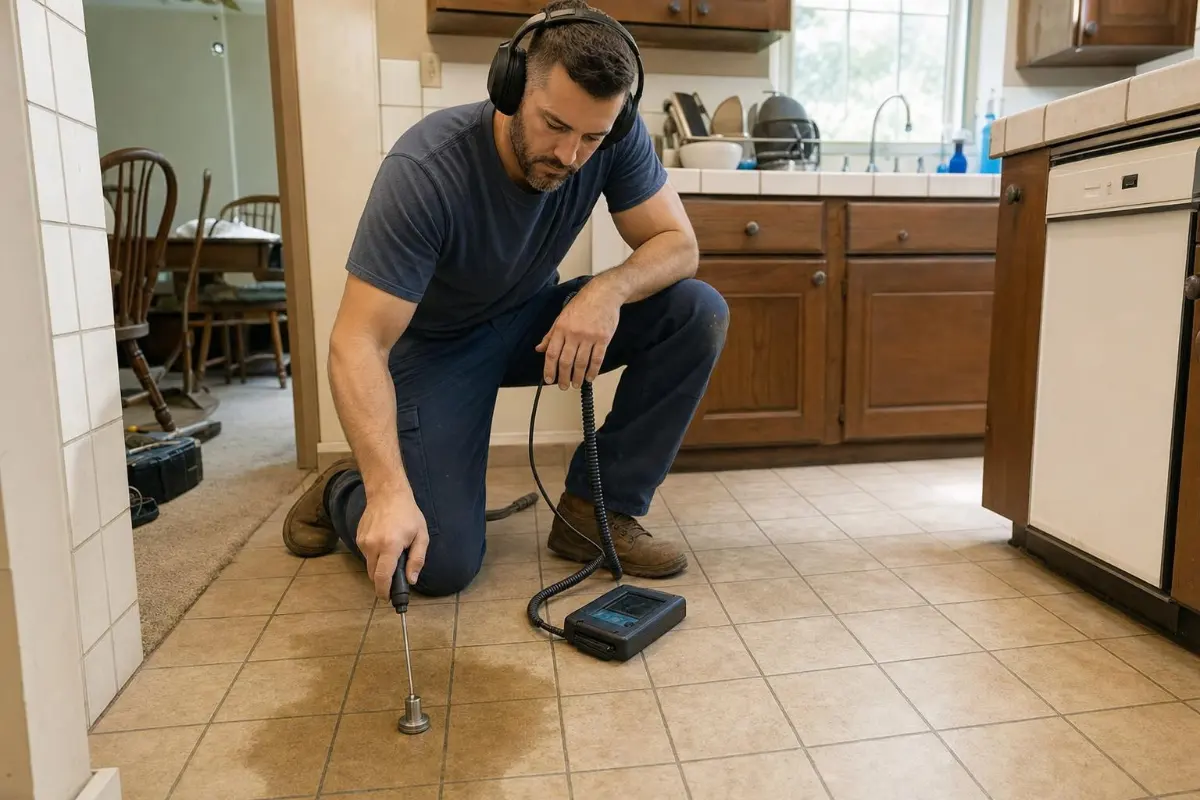
Some leaks announce themselves with a drip or a puddle. Others hide: a pinhole in a pipe inside a wall, a hot water line under a slab, or a break in the water line out in the yard. The first clue is often a water bill that jumps for no reason, a meter that keeps moving with every faucet off, a warm spot on a floor, a stain on a ceiling or the faint sound of running water at night. In an apartment building, it may be a stain that shows up in the unit below.
The plumber you are connected with locates the leak, explains the repair options and gives you a price before any walls or floors are opened. Callbacks and on-site availability vary.
Signs of a Hidden Leak
- A higher water bill without a change in use.
- The meter moving when nothing in the house is running.
- Stains, bubbling paint or soft drywall on walls and ceilings.
- Warm spots on a floor, which can point to a hot water line leaking under a slab.
- Musty smells, mold or damp carpet.
- A wet or unusually green strip in the yard along the path of the water line, even in the dry months.
A simple check: turn off every fixture and appliance that uses water, then watch the meter. If it still moves, water is going somewhere.
Your Side of the Meter
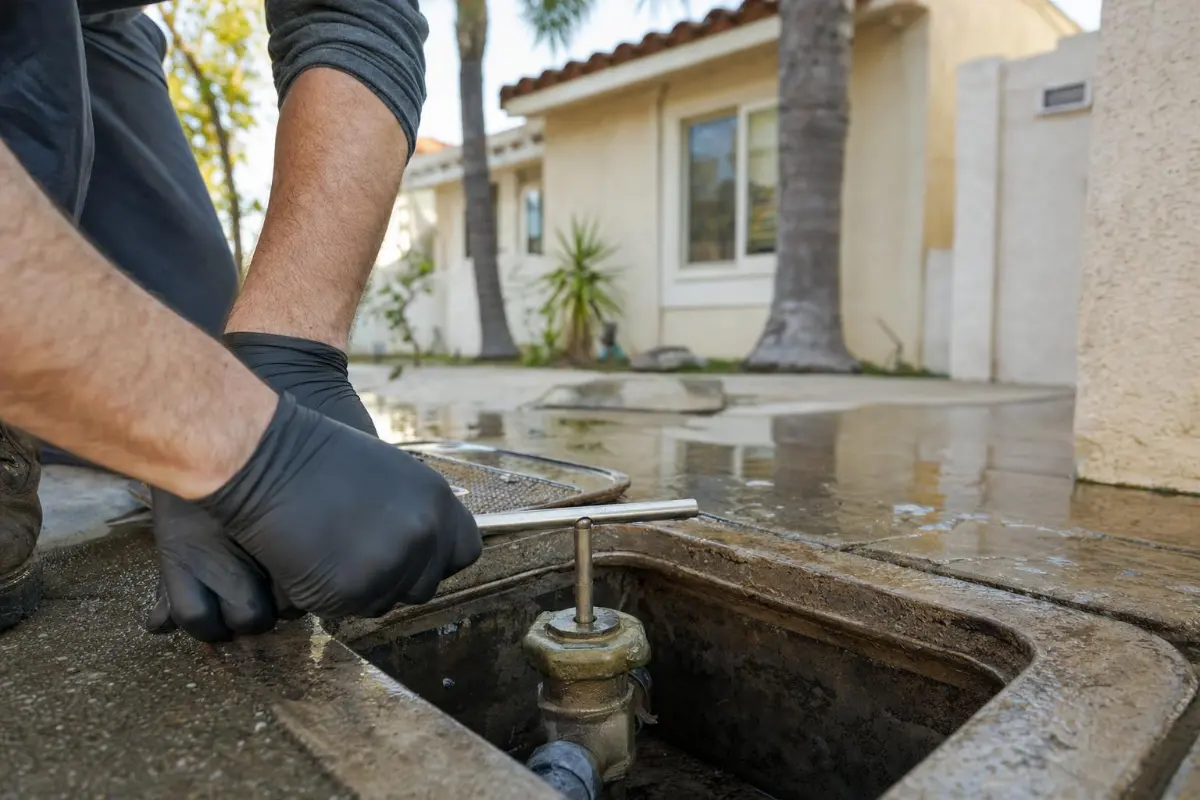
A leak in the main in the street or at the meter is for your water provider: the City of Inglewood for most of the city, or Golden State Water or California American Water for some addresses. Your bill shows which. The line from the meter to the house is plumbing work; California's C-36 license covers water piping "from the owner's side of the meter to the building."
How Leaks Are Found and Fixed
Plumbers find hidden leaks by isolating sections of the system, pressure testing lines, listening for the sound of escaping water, and using moisture meters or thermal imaging, so the opening in the wall or floor can be as small as possible. Ask what method they will use and what the detection fee includes.
Repair options depend on where the leak is:
- Exposed pipe or fixture: repaired or replaced directly.
- Inside a wall or ceiling: a section opened, the pipe repaired, and the wall patched by the plumber or a separate drywall contractor.
- Under a slab: a direct repair through the slab, or rerouting the line through walls or ceilings to abandon the leaking section.
- Water service line: a spot repair or replacement of the line from the meter to the house, with the digging rules below.
Older Pipes, Hard Water and Earthquakes
Three local conditions make leaks more likely. First, age: SCAG's housing data shows about 54 percent of Inglewood homes built before 1960, by our math, and pipe of that era, often galvanized steel, corrodes from the inside. Second, hard water: the City of Inglewood's 2021 report shows average hardness of 223 and 293 milligrams per liter for its two sources, and minerals build up in valves and fixtures. Third, earthquakes: shaking can loosen fittings and break rigid connections, which is why SoCalGas recommends flexible gas connectors and the state's strapping guidelines recommend flexible water and gas connectors on water heaters.
California's State Water Board found "no lead reported in nearly 10 million service connections" statewide, but suggests checking fixtures and interior piping installed before 2010. If leaks keep showing up in the same kind of pipe, ask whether a section or whole-house repipe makes more sense than chasing pinholes.
What Leak Detection and Repair Cost
The plumber sets the price. These are guides:
- Los Angeles (Angi; the page does not date its data): plumber visit average $385, typical $193 to $600; service call or diagnostic fee $100 to $250 (Angi, Los Angeles).
- National leak detection and slab leaks (HomeAdvisor, labeled 2025): detection averages $280, most pay $150 to $400; slab leak repair averages $2,280, most jobs $630 to $4,400, with a full range of $300 to $6,750; rerouting a line $600 to $4,000; a pinhole leak $150 to $800; a single burst pipe $200 to $3,000 (HomeAdvisor).
What moves the price: how hard the leak is to find and reach, slab versus wall versus yard, the pipe material, how much drywall, flooring or concrete has to be opened and restored, and whether a reroute or repipe is the better fix.
Permits, Digging and Backflow
Replacing concealed pipe or a water service line generally needs a permit: from City of Inglewood Building and Safety inside city limits, per 211LA's listing, or from LA County Public Works through EPIC-LA in unincorporated Lennox, Ladera Heights and Westmont. Ask the plumber who will pull it. If the water line has to be dug up, call 811 at least two business days ahead, per SoCalGas's safety insert. And if your water provider requires a backflow test, it must be done by a certified tester. Look up any plumber's license on the CSLB's Check A License search.
A note on how this works: Inglewood Plumber Help is an independent referral service, not a plumbing company. Your request goes to an independent plumbing contractor who serves Inglewood, and there is no charge for the referral.